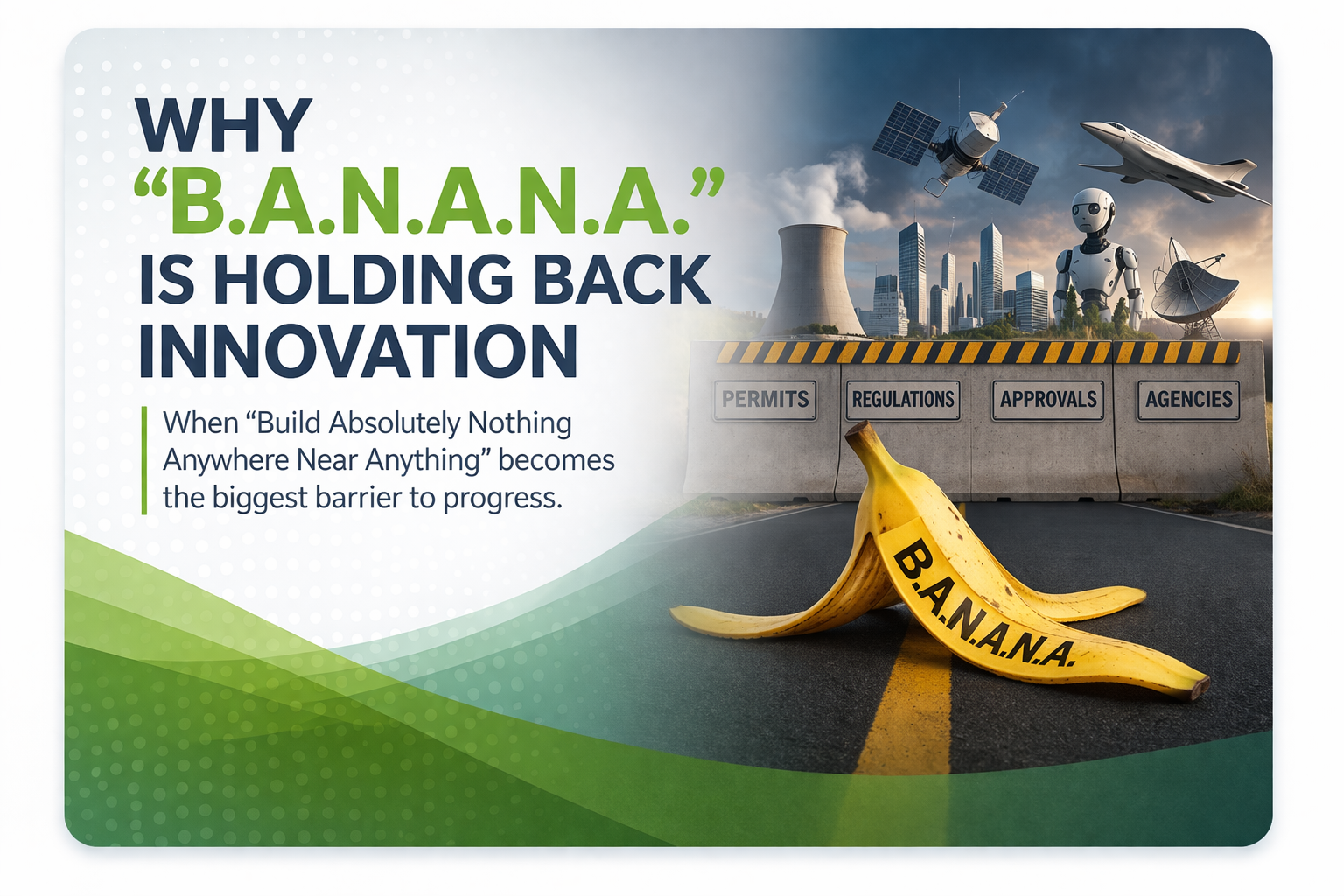
Stephen McBride’s recent article, “We Must Defeat B.A.N.A.N.A.”, is a sharp reminder that the future is not guaranteed, it has to be built. In it, he describes a research trip talking with founders working on mini nuclear reactors, asteroid mining satellites, supersonic jets, flying robots, AI tutors, and more. After more than 40 founder conversations, the takeaway was sobering, “The B.A.N.A.N.A Blight” is still a major barrier, an absurd tangle of rules and agencies that is choking innovation and making it nearly illegal to build ambitious things in the physical world. The result is what he calls a B.A.N.A.N.A. economy, Build Absolutely Nothing Anywhere Near Anything.
Why it’s so damaging to innovation in the US and Canada
It turns time into the enemy. When approvals take years, innovators burn cash, miss market windows, and investors shift money to “lighter” bets like software, where you can ship fast.
It raises the cost of ambition. Big, physical-world innovation, energy, housing, manufacturing, critical minerals, transmission, data centres, requires permits, land use decisions, and community engagement. If every step is uncertain, fewer projects get proposed at all.
It rewards incumbency over challengers. Large firms can afford lawyers and delays, many SMEs and startups cannot, so the next generation of builders get crowded out.
It worsens affordability and competitiveness. Canada’s housing crunch, for example, is widely linked to regulatory barriers and long permitting timelines, which push costs up and supply down. (C.D. Howe Institute)
Bottom line
Bottom line: a BANANA environment doesn’t just stall big ideas, it slows momentum across the economy, because prosperity is built through action, learning, and scaling what works. When “no” becomes the default setting, progress and innovation gets harder than it needs to be.